




Mongolia is a vast land of incredible landscapes, wonderful bird and mammal experiences, and with a fascinating history and way of life. Our tour is one of the most thorough birding itineraries available yet still covers only a fraction of the country. Visiting a wide range of habitats we were treated not only to the very special breeding birds like lekking Black- billed Capercaillie, Hodgson’s Bushchat, Altai Snowcock, Relict Gull, Oriental Plover, Mongolian Ground Jay, Saxaul Sparrow, Pallas’s Sandgrouse, and the charismatic Kozlov’s Accentor, but also some exciting passerine migration and special waterbirds like Asian Dowitcher, Baikal Teal and Baer’s Pochard.
A nice range of mammals complimented the birds nicely, highlighted by Saiga, Przewalski’s Horse and Asiatic Wild Ass, Mongolian and Goitered Gazelles, Corsac Fox, Siberian Ibex, and numerous ground squirrels, jerboas, and a broad spectrum of rodents.
The weather was pleasant through most of our journey, allowing us to appreciate not only the dramatic landscapes, but also enjoying an interesting range of butterflies, herps and flowers.
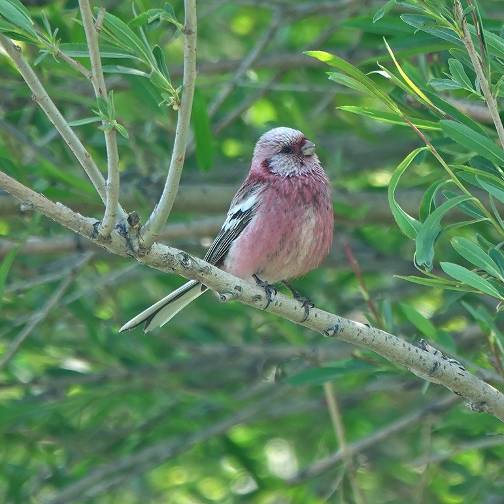
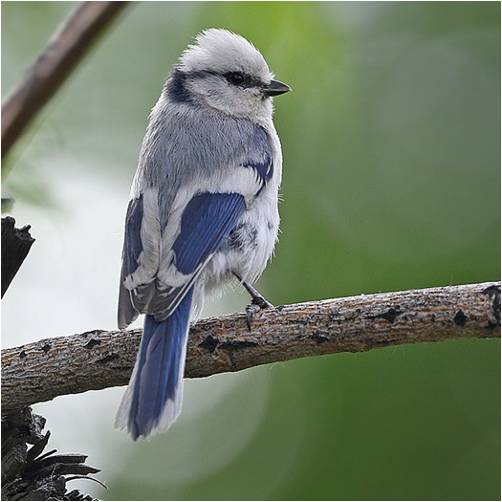
We kicked off the first morning around the grounds of our hotel just outside the capital Ulaanbaatar, with Azure Tit the highlight, along with support from a double figure count of Hawfinch, our only White-cheeked Starlings of the tour, and a selection of migrants such as Dark-sided Flycatcher, Dusky and Arctic Warblers. Exploration of an area of scrub and pools nearer Ulaanbaatar was productive for the stunning Siberian Long-tailed Rosefinch and confiding White-crowned Penduline-tit, as well as an excellent waterbird selection well into breeding activity with Greylag and Swan Geese already
with goslings in tow, Great Crested and Black-necked Grebes looking resplendent in breeding dress. A migrant Richard’s Pipit was appreciated, one of only two seen during the tour.
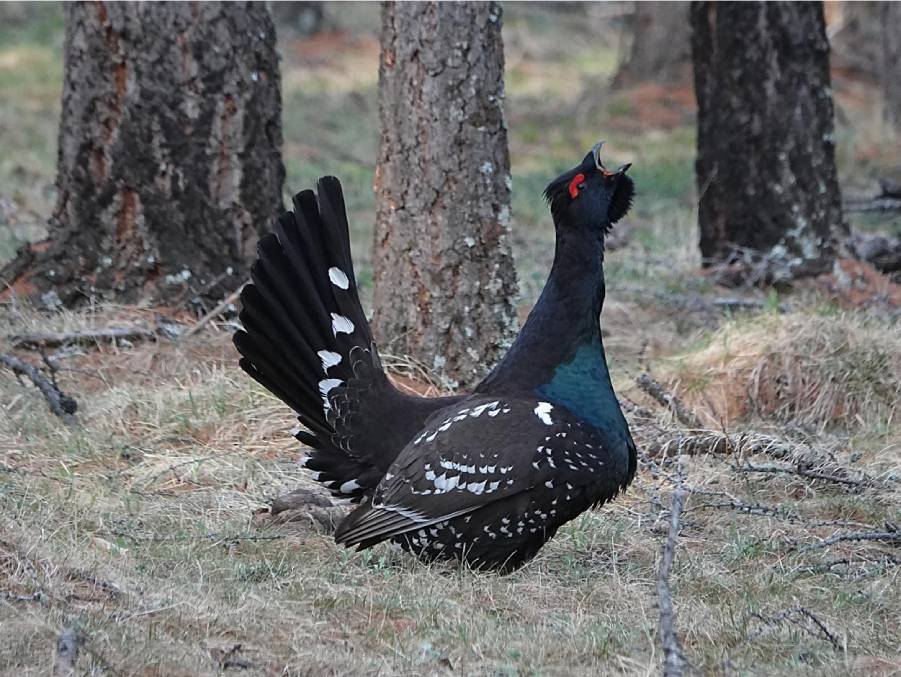
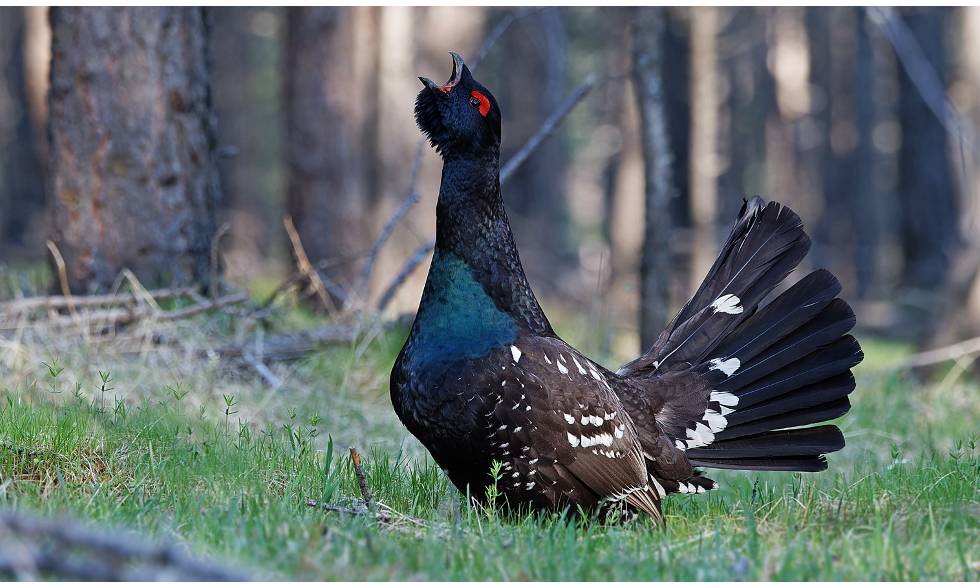
Continuing east with Black Kites and Daurian Jackdaws as roadside companions, we were soon in the scenic Gorkhi- Terelj National Park, our lunch stop adding our first of many Blyth’s Pipits, a passing Amur Falcon, elegant Demoiselle Cranes and migrants like Black-faced and Little Bunting, plus a bonus Critically Endangered Yellow-breasted Bunting, now a rare breeding bird in the country. Our primary reason for visiting the park was to search for Black-billed Capercaillie, an impressive forest resident that is typically difficult to locate despite its huge size. Anticipating a long search to find one, we were astonished when one appeared in full view within minutes of our arrival and proceeded to give extended and unobstructed views. Even more amazingly this was just one of five individuals enjoyed during the afternoon, along with dapper Pine Buntings, Red-flanked Bluetails, Olive-backed Pipits, Taiga and Asian Brown Flycatchers, and more. An amazing start to the tour but things were to get even better the next morning as we woke to the distant clicking sounds of displaying capercaillies in the nearby forest. Making our way stealthily towards the birds, the sounds became steadily louder until we had sight of several males strutting about with tails cocks and heads thrown
back to fill the forest with weird mechanical noises. The birds were more interested in each other than us, and we enjoyed fabulous views for as long as we wanted. In the same forest a calling Eurasian Pygmy Owl frustrated by only showing in flight, but after a celebratory breakfast a birding session added Red-throated, Naumann’s and Dusky Thrushes, and Brown Shrikes sometimes perching several to a tree.
After a stop to admire the imposing Genghis Khan Equestrian Statue, with bonus migrants like Siberian Rubythroat, we battled through Ulaanbaatar traffic and onto the open plains west of the city and our first views of Mongolian Gazelles by the roadside. Mongolian Larks started to appear by the roadsides with their conspicuous white wing patterns, before arriving at Khustain Nuruu National Park in time for lunch, and an exciting afternoon exploring the park. Khustain Nuruu is home to the largest re-established population of Przewalski’s Horse (locally known as Takhi) in their former native range, and we were treated to numerous encounters including newborn foals. Khustain Nuruu is one of only three localities in Mongolia where Przewalski’s Horse has been re-established having become extirpated in 1966, and the population here now approaches 500 individuals out of approximately 1,400 known in the wild. Other mammals were conspicuous in the park, not least the many Tarbagan Marmot rushing for cover, several rangales of Wapiti, and Long-tailed Ground
Squirrels. There were also some important birds to locate, and we found several Daurian Partridges, and Meadow Buntings perched conspicuously. Amur Falcon were in good numbers, close views of Golden Eagle, and our first of many Upland Buzzards and Steppe Eagles.
The evening gave our first experience of staying in Gers, a traditional form of accommodation that has been used for thousands of years in Central Asia, and especially Mongolia to facilitate a nomadic life. Gers are portable, collapsible, circular rigid tents that are now used widely as homes and as quirky but convenient tourist accommodation. They are indeed ideal, very spacious and practical and in tourist camps come replete with electrical charging and clean toilets and shower facilities. After a comfortable night we continued west with short stops at a couple of river crossings where excellent views were enjoyed of the many Common Swifts, Western House Martins, and the distinctive tytleriBarn Swallows with brick-red underparts, all nesting under the road bridge.
We soon made our first of several wetland stops scattered along our tour route, at Bayan Nuur. Nuurs (lakes) in Mongolia tend to be havens for waterbirds and Bayan was no exception with impressive concentrations of 19 species of waterfowl including Falcated Duck and supported by our first (of many) White-naped, Demoiselle and Common Cranes, Eurasian Spoonbills, and skies filled with quartering Eastern Marsh Harriers. Reedy edges were alive with Paddyfield and
boisterous Oriental Reed Warblers, Common Reed and the distinctive lydiaePallas’s Reed Bunting which is very likely to be split from the nominate birds as ‘Mongolian Bunting’. A couple of Brown-cheeked Rails called, one of which poked out
from the reed edge on a couple of occasions. The shallow margins held a nice wader selection, mostly in breeding dress, including a single Long-toed Stint, and numerous Little and Temminck’s Stints, Dunlin, Broad-billed Sandpiper, Pacific Golden Plover, and a Red-necked Phalarope. Like many of the waterbodies visited during the tour, hundreds of White- winged Terns dip-fed from the surface, and a couple of Black Terns were found.
We took our lunch at another productive marsh at Elsen Tasarkhai where new additions were a dapper Black-throated Diver, Slavonian Grebes, migrating Black Storks, Eastern Spot-billed Ducks, and another pair of White-naped Cranes with their colt barely a few days old.
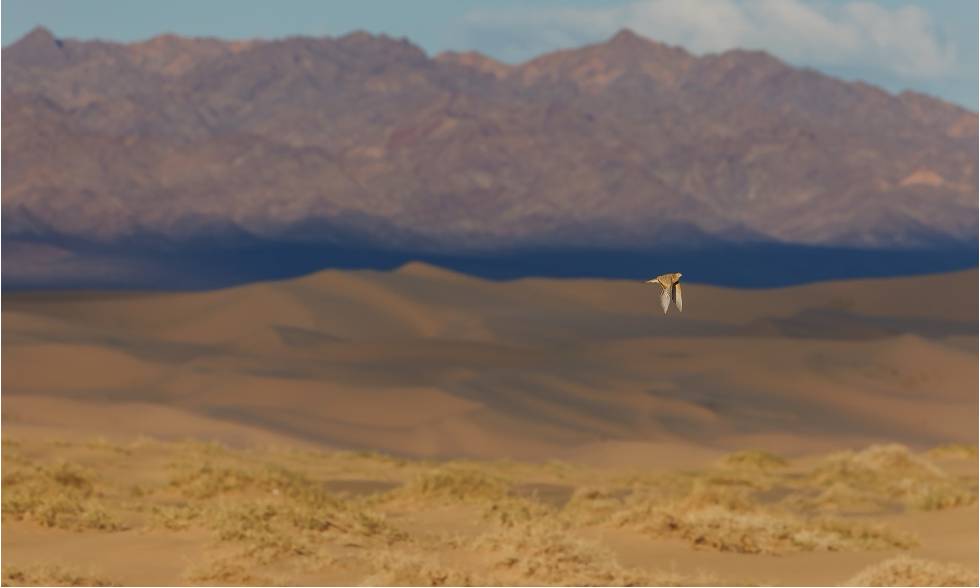
Just a few hours’ drive further on, with many Isabelline Wheatears, Asian Short-toed and Mongolian Larks gracing the roadsides, we made camp at Sangiin Dalai Nuur and spent the late afternoon birding the main lake and nearby marshes. Highlight was an Asian Dowitcher in gorgeous summer dress, two Grey-tailed Tattlers feeding actively before heading off north was unexpected, several Swinhoe’s Snipe and our first Common Goldeneye were noted, and after a lot of searching a single Ferruginous Duck. Once again the numbers of birds impressed us here with the hundreds of Demoiselle Cranes particularly impressive. The day finished with the first Pallas’s Sandgrouse of the tour passing over at dusk.
It took most of the day to reach the remote Khukh Nuur but stops along the way were appreciated for our first views of Pere David’s Snowfinches and nesting Saker, plus many more looks at roadside Upland Buzzard, Steppe Eagle, Cinerous Vultures feeding on a carcass, Demoiselle Cranes, and ubiquitous Horned Larks and Isabelline Wheatears. Another stop at a river crossing paid off when we found a pair of Siberian House Martins among a colony of their Western
counterparts, with views from above ideal to note the diagnostic white uppertail coverts (versus dark of the former). Lunch was taken at another lake, this one giving us our first Stejenger’s Scoter, breeding-plumaged Tibetan Sand Plover and an impressive Dalmatian Pelican that dropped in for a break, now something of a rarity this far east.
Our drivers skilfully navigated the dirt roads which would now predominate for large parts of the tour, and in the evening our crew set up yet another perfectly appointed camp next to the still partly frozen lake, with a rocky ridge towering
above us. It was on these rocky slopes that the wailing calls of Altai Snowcocks emanated early the next morning, and we soon had two posing in the ‘scopes for as long as we wanted. Not only this but we were soon onto a fine male Hodgson’s Bushchat, another of our main targets here as it’s an extremely tough bird to find elsewhere, on either its breeding or wintering grounds. We would go on to see several more bushchats during the day and a lovely post-breakfast walk gave
the distinctive sushkinirace of Asian Rosy Finch – colloquially known as Khangai Rosy Finch, many Brown Accentors, and nominate Pallas’s Reed Bunting as a contrast to the birds seen the previous day. Migrants were passing with Dusky, Two- barred, Hume’s, Arctic, and Pallas’s Warblers in good numbers, Asian Brown Flycatcher fed on a scree slope, Siberian Rubythroat, Eversmann’s Redstart, Black-faced and Ortolan Buntings were noted. Lammergeier and Himalayan Griffon were regular sights overhead, and the nearby breeding colony of Mongolian Gulls provided a constant soundtrack. The
fine weather had clearly persuaded some species onto the upper slopes and we were only able to see Altai Accentor as great distance. With this in mind some of the group walked up onto the ridge in the afternoon, enjoying not other
spectacular views of the surrounding Khangai Mountains, but also astounding views of Altai Snowcock charging up the slopes towards us, point-blank looks Altai Accentor, Twite, more ‘Khangai Rosy Finches’, Güldenstädt’s Redstart for some, and a pair of Rock Ptarmigan wherein the male still in its predominantly white winter suit contrasted markedly with the intricately barred female.
A final session at our camp was packed away gave beautiful views of Stejneger’s Scoter, and another Güldenstädt’s Redstart way, way up on the ridge. Bidding goodbye to this spectacular area we made our way westwards again, initially on dirt roads again during which a stop for minor car repairs repaid with spectacular views of nesting Pere David’s Snowfinches and our first Hill Pigeon. Soon enough we hit wonderfully smooth asphalt as we cruised through Altai City before a last dirt road section delivered us to Ikhes Nuur for a late afternoon birding session. This saline lake is one of the few accessible breeding lakes for the rare and beautiful Relict Gull, one of the least known gulls on the planet. While we didn’t see any breeding activity, we did count more than 270 individuals, almost all of which were in superb breeding dress, and some were paired up and displaying to one another. Many of them offered superlative views as they visited a fresh-water inlet to bathe, along with a heugliniLesser Black-backed Gull which is seemingly a rarity in Mongolia. A small selection of waders included Sanderling and Greater Sand Plover, while the grassy surrounds had Western Yellow Wagtails, which here at the eastern edge of their range the included the highly-restricted white-headed leucocephala subspecies, as well as beemaforms and some apparent intergrades. The morning was even better, bathing both the gulls and other waterbirds in glorious sunlight, and the millpond calm lake waters reflected the distant mountains and feeding birds. Greater Sand Plover and Kentish Plovers were admired, and Pied Avocets were abundant. Departing the area via a
different route we headed southeast into Sharga Nature Reserve – home to the Saiga. This bizarre Critically Endangered antelope, most closely related to Springbok, once grazed from western Europe through to eastern China, but now only survives in pockets from here to western Kazakhstan. They have huge, bloated nostrils, allowing them to filter out dust
when herds running, as they are so tightly-packed together – something we were able to the witness, as they ran at high speed through the stoney steppe, with their heads down reminiscent of pigs. ‘Mongolian’ Saiga home ranges are vast, and there is no guarantee to locating them, but we spotted around 120 individuals during the morning and given the total Mongolian population is fewer than 5,000, we felt extremely fortunate. We were also able to enjoy excellent views of Goitered Gazelles before heading back east with Pallas’s Sandgrouse abundant on the drive and pallidirostris‘Steppe’ Great Grey Shrikes appearing. It was a pleasantly short drive today to our lakeside camping spot, stopping at a tiny town park for a productive migrant session with Barred and Thick-billed Warblers, and personataWhite Wagtail as highlights. The lake itself had large numbers of waterbirds, that included a flock of 10 Mute Swans, a common sight across Europe thanks to long-established introduced populations, but fantastic to see here in their native range.
We also logged our first Mongolian Finches and Godlewski’s Buntings, both of which would be seen again repeatedly over the next week, and incredible eye-level views of Common Swifts nesting in a nearby rock formation. As we moved on a random stop for a leg-stretch gave us the major surprise of several Kozlov’s (or Mongolian) Accentors in the surrounding vegetation. This might not be the most colourful species on the tour, but it makes up for this with great charisma, and a species we don’t typically find until much later in the tour. It is also Mongolia’s only breeding endemic and the last of the world’s Prunellidaefor both Alan and Charles was a cause for celebration. Further stops gave particularly good looks at
roadside Saker Falcon, and at a trackside pond there were Pallas’s Sandgrouse all around Desert Wheatear and fine looks at Mongolian Finches coming to drink.
We arrived at our overnight accommodations by lunch time, accompanied by Hawfinch in the garden, and in the afternoon explored the adjacent Böön Tsagaan Nuur. a vast Ramsar Wetland of 252 km2. We concentrated on the nearest parts of the shore and an adjacent marsh, finding impressive Pallas’s Fish Eagles, glorious breeding-plumaged
Pallas’s Gulls, two more Mute Swans, and our first Caspian Terns and Eurasian Curlew, and a pair of Brown-headed Gulls in the Black-headed Gull colony. Vast numbers of waterbirds included over 1,000 Great Cormorants and careful scanning revealed one of the rarest finds of the tour, a male of the Critically Endangered Baer’s Pochard in the company of Ferruginous Ducks and Common Pochard. In the evening, we were treated to a spectacular storm gathering over the lake with the horizon lit by streaks of lightening, before we headed inside to avoid the resulting sandstorm, grateful that we’d spend the night in the wooden cottages of the local camp rather than in our tents. The storm was long gone by morning, and we enjoyed a few serene hours watching the lake in perfect light, the Baer’s Pochard was again the star but a pair of Red-necked Phalaropes were equally appreciated, Western Marsh Harrier passed by, and an incredible 240 Great
Crested Grebes had appeared overnight to decorate the nearby lake. Pallas’s Sandgrouse were again abundant as we passed through more desert area, and a couple of stops were made for close-up views of Little Owls. A longer stop at a particularly birdy marsh gave wonderful views of Falcated Ducks, and careful scanning of a reedy edge found a pair of Baillon’s Crakes, Little Bittern, and a Pallas’s Grasshopper Warbler hopping around in the open.
We took lunch at a small settlement en route where migrants included Spotted Flycatcher and Common Redstart. A stop at Kholboolj Nuur gave us more views of Asian Dowitchers in breeding dress, alongside equally attractive Black-tailed Godwits. Ruddy Turnstone was new and Mike spotted us a glorious drake Baikal Teal to add to the impressive waterbird haul. Unfortunately, our last stop of the day was less productive than expected as we found the usually vast Orog‘Nuur’ to be bone dry! At least the nearby reedbeds still hosted some Bearded Reedlings, a charismatic species in their own family, and with no distractions we were on our way nice and early the next day. We were soon in suitable habitat for
Mongolian Ground Jay, and sure enough one responded within minutes and offered us wonderful looks. Both Asian Desert Warbler and Desert Wheatear appeared in the same area, and the first of many ‘Steppe’ Grey Shrikes performed. Saxaul Sparrows completed our haul of desert species and multiple Pallas’s Sandgrouse completed the Gobi Desert experience, the latter numbering into the hundreds during the tour and always drawing gasps of appreciation from the group. A lunchtime search for eagle owls wasn’t successful but breeding Lesser Kestrels put on a fine performance. We indulged again in ‘real’ beds and unlimited hot showers at our overnight tourist camp, where Long-eared Hedgehog, Siberian, Northern Three-toed, and Gobi Jerboas were found at night.
Oriental Plover
Continuing through the Gobi we were delighted to find a small group of Asiatic Wild Ass, known locally as Khulan, plus more fine views of both Goitered and Mongolian Gazelles. A stop in a rocky canyon was a pleasant change of scenery with plenty of Godlewski’s Buntings on show, perched Lammergeier, nesting Eurasian Crag Martins, and rather incongruous Little Ringed Plovers! By late morning we’d reached the flat stoney steppe that is the favoured breeding
habitat of Oriental Plover, finding two fine white-headed breeding-plumaged males of this elegant species, which showed superbly both on the ground and in distinctive display flight. The afternoon and early the next morning we spend in the hope of finding a Snow Leopard, but we left instead with Siberian Ibex and our first Chukars. The plantation next to our camp held a handful of migrants such as Radde’s Warbler, Siberian Rubythroat, and a group of Lesser Kestrels dropping
in to roost.
A storm arriving overnight thwarted our plans for a morning visit to the Yol Valley and we instead started with a visit to a city park where a good selection of migrants including several Pallas’s Warblers, were complimented by a rare breeding species in Mongolia, a pair of Desert Finches. Some small ponds near our lunch spot added Black-crowned Night Heron, Chinese Pond Heron and a Daurian Starling before we headed to Yol Valley, our decision to delay rewarded by fabulous sunny weather in which to enjoy this wonderfully scenic area. There were plenty of other visiting tourists but the birds were nonplussed with White-winged Snowfinches, Twite, and Mongolian Finches delightfully confiding. We also had fantastic looks at the local beautiful rosefinches which led to some taxonomic debate as they are variably considered either Himalayan of Chinese, although we concluded on plumage and voice they are surely the latter. Himalayan Griffon, Lammergeier and Golden Eagle offered amazing views overhead, and on the steep cliffs we found the highly desirable Wallcreeper. Mammals included Alashan ground Squirrel, Pallas’s and Daurian Pikas. Another comfortable Ger camp left us well rested before a long ride back north towards Ulaanbaatar the next day, a comfortable ride on nicely surfaced roads. Stops along the way gave our first Long-legged Buzzard, and the now expected Saker Falcons, Golden and Steppe Eagles, while our lunch stop produced good numbers of Cinereous Vultures gathering to feed on a nearby carcass. We bypassed the capital city and headed east again to Terelj.
Mongolian Finch and Chinese Beautiful Rosefinch
Our afternoon and much of the next day here was focussed on trying to find the late-returning Chinese Grasshopper Warbler which sadly hadn’t yet return (but typically showed up the day after we left!). Nevertheless, the birding here was most enjoyable and we were able find Daurian Redstart, stunning male Siberian Rubythroats, impressive Black Woodpecker, Oriental Cuckoo, Eurasian Goshawks, side by side comparisons of Tree and Olive-backed Pipits, and forests filled with the calls and songs of Common Rosefinch, Yellow-browed and Dusky Warblers. We also enjoyed close studies of a pair of Red-throated Thrushes, a big improvement on our previous views. This bought this wonderful tour to an and we returned to Ulaanbaatar in high spirits and a final evening meal rejoicing in all the wonderful birds, mammals and experiences we’d packed into the last few weeks.
We’d covered more than 4,000km on our grand tour of Mongolia, amassing 239 species of birds (two heard only) and 26 species of mammal identified (we didn’t tackle the bats!), and of course unforgettable memories of this rich and varied country.
Birds of the tour


© 2026 Tum-Eco Tour Co.,Ltd. All right reserved. Developed by Mind Agency