



Mongolia 20th May-3rd June 2025 18 May 25 Evening departure from London Heathrow
19 May 25 Istanbul Evening departure for Ulaanbaatar
20 May 25 Mongolica Hotel near Ulaanbaatar
21 May 25 Zamt
22 May 25 Zamt Baga Gazriin
23 May 25 Baga Gazriin Dalanzadgad
24 May 25 Yolyn Am
25 May 25 Drive from Yolyn Am to Khongorin Els Khongorin Els
26 May 25 Drive from Khongorin Els to Bogd Baga Bogd Mountain
27 May 25 Baga Bogd Mountain Orog Nuur/Kholboolj Lake
28 May 25 Boon Tsagan Nuur
29 May 25 Boon Tsagan Nuur Khukh Nuur
30 May 25 Khukh Nuur
31 May 25 Khukh Nuur Gun Lake
01 Jun 25 Gun Lake Takhilt Lake Hustai NP
02 Jun 25 Hustai NP Mongolica Hotel near Ulaanbaatar
03 Jun 25 Flight from Ulaanbaatar to London Heathrow via Istanbul Sunday 18th May Along with Alan Lewis, Mick Ilett and Simon King, I took a Turkish Airlines flight from London Heathrow terminal 2 bound for Istanbul. The flight departed on time (which was highly unusual for LHR).
Monday 19th May We arrived at Istanbul ahead of schedule at about 03:30. We tried to grab a bit of sleep on the chairs in the departure area then, at 08:30, we joined a complimentary city tour of Istanbul. It was very much a time killing exercise, though the blue mosque was quite impressive. We had several sightings of Pygmy Cormorants in flight, plus one individual sitting in a tree. We had a poor complimentary breakfast and a lunch of similar quality before reboarding the coach and returning to the airport. We were back at the terminal by 15:00 and still had another three and a half hours before our onward overnight connection to Ulaanbaatar. We met Trevor Ellery who was on the same flight; he was off to lead a Birdquest tour.
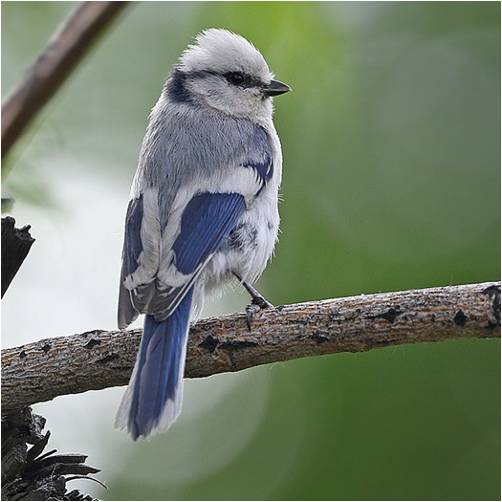
Tuesday 20th May We arrived at Ulaanbaatar at about 07:30, pretty knackered after 2 overnight flights. We were met by our guide, Uugaa, and driven for about 45 minutes to the Mongolica Hotel, close to the Tuul River just west of Ulaanbaatar. A few Demoiselle Cranes were noted en route. After dropping our bags off in the rooms, we set off on foot to explore the sparse woodland in the vicinity of the hotel. We easily found several very smart Azure Tits, whilst a pair of White-crowned Penduline Tits took a little more effort. The general birding was very good; other notable species included Daurian Jackdaw, Amur Falcon, Arctic, Dusky & Pallas’s Warblers, Bar-headed & Swan Geese, White-cheeked Starling, Daurian Redstart and 3 excellent Hawfinches. We returned to the hotel for lunch, where we discussed some proposed route changes with Uugaa. We had a short post lunch rest and then embarked on another walking jaunt from the hotel. We covered much the same ground, venturing a little further afield this time. The species seen were broadly similar to the morning session, though we did add Yellow-breasted, Little and Black-faced Buntings. In the evening, tour company co-owner Oyuna came to the hotel to finalise the arrangements and relieve us of a heavy wedge of cash.
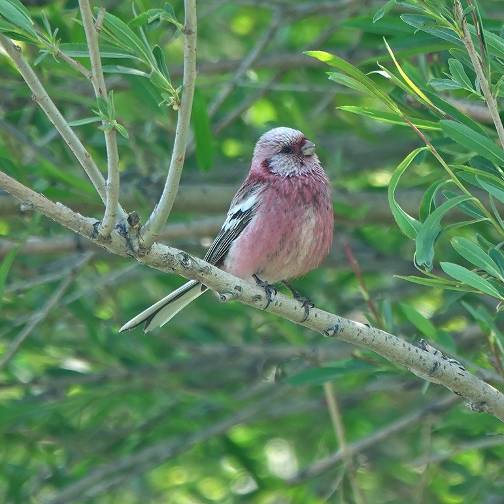
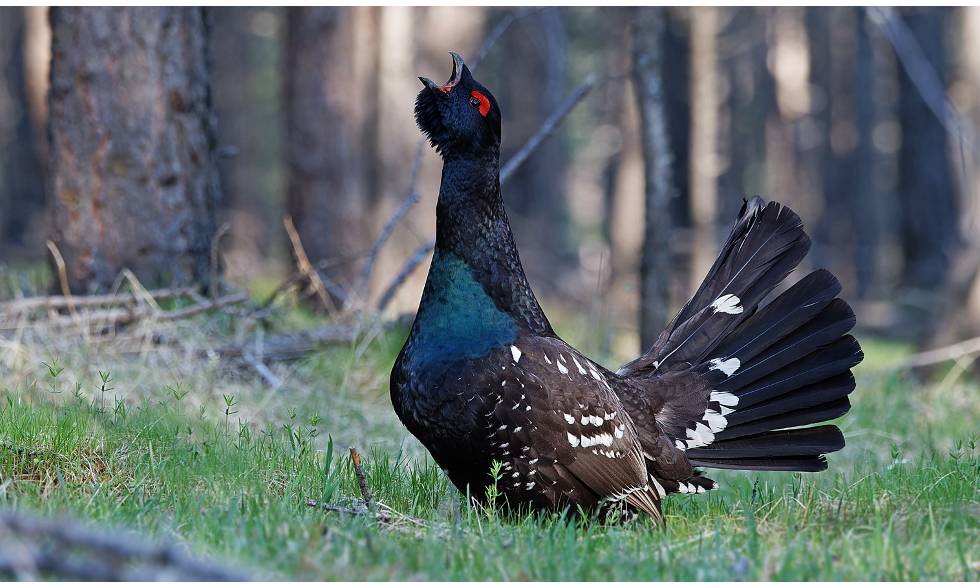
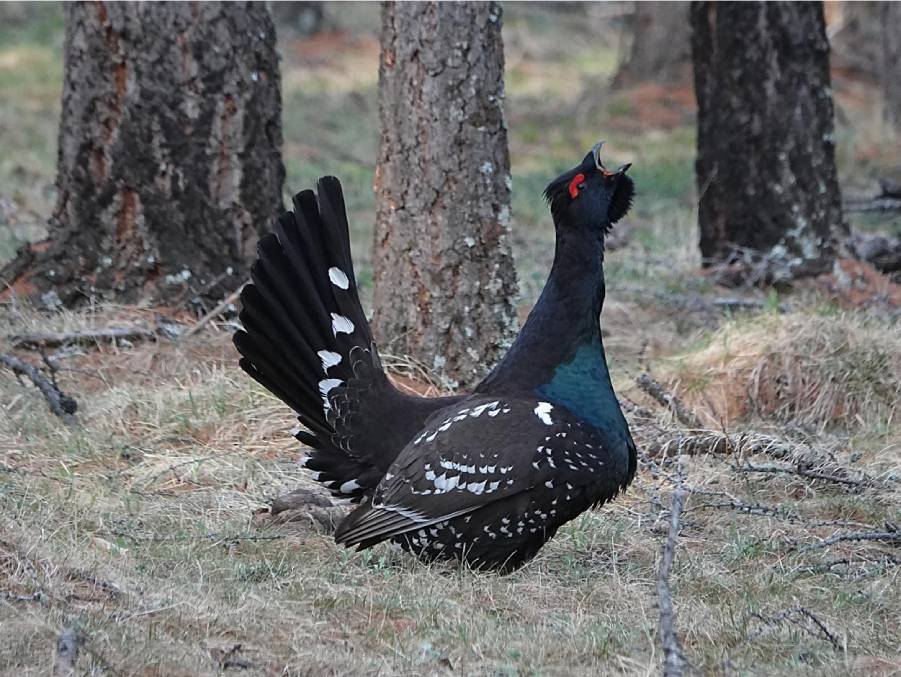
Wednesday 21st May We had breakfast at the Mongolica Hotel at 05:30. A brief foray in the grounds provided nice views of a male Long-tailed Rosefinch. We were on our way in 2 four-wheel drive vehicles (with a 3rd catering vehicle going on ahead) at about 06:00. We drove around the south side of Ulaanbaatar, noting a roadside colony of House Martins en route, though we were moved on quite quickly as they were on a military building; we had expected them to be Siberian House Martins but retrospective examination of photos showed them to be Western House Martins. We stopped for photos at the Genghis Khan Statue, before continuing onwards to Zamt, with a Black Vulture seen along the way. We arrived in the larch forest/open pasture mosaic in the Zamt area at about 09:30. It didn’t take long to find the target species – the highly-desired BLACK-BILLED CAPERCAILLIE. We very quickly found a rather tatty male from the vehicles, soon followed by a much smarter male. After admiring these fine birds, we drove a few hundred metres further up the hill to our camping area, where there were 3 more male Black-billed Capercaillies in the surrounding woods, 2 of which gave awesome views down to just 3 or 4 metres at times – a fantastic experience. A late morning circuit around the general area in the vicinity of the camp was mostly spent taking prodigious quantities of photos of the Capers, but we did also see Pine Bunting, Red-flanked Bluetail and Upland Buzzard. We spent the afternoon birding within a few kilometres of the camping area. A nice selection of birds included Wryneck, Willow Tit, Red-throated Thrush, Eye-browed Thrush and a confusing array of Naumann’s/Dusky Thrush types (several were clearly intergrades). It was quite cold in the evening as we enjoyed a very nice meal at the camp site before settling in to the tents for the night.
Thursday 22nd May We were awoken in our tents at Zamt by Black-billed Capercaillies calling from the adjacent larch forest. Once there was a grain of light, we began venturing into the woods. We initially found a couple of males perched in pine trees and, after a bit of a wait, about 4 further males were seen displaying on the ground. Another group with a guide showed up, which made things a little challenging, but we cut off on our own and we were rewarded with magnificent views of a displaying male at close range, which we were able to follow through the forest for some time. Back at the tents and waiting for breakfast, we had a few fly-overs including Common Crossbill, Golden Eagle and Richard’s Pipit, plus a Brambling perched up. We had breakfast at 08:00 and then left at about 08:45 for the long drive to the next site. We had a field lunch stop in a steppe area south of Ulaanbaatar, where we encountered Pere David’s Snowfinch, Pallas’s Reed Bunting, Asian Short-toed Lark and a herd of Mongolian Gazelles. In the afternoon we cut off the main road onto a series of dirt tracks across short grassy plains, heading towards Baga Gazriin. We made multiple stops along the way – the standout highlight was Oriental Plover, with 5 individuals at 3 spots, including 3 males in their curious aerial display flight. Other species noted included Saker Falcon and a selection of waterside birds. We arrived at our camp site by a series of low rocky outcrops late in the afternoon. We scouted around whilst the tents were being erected, adding Pied Wheatear and Rock Sparrow to the day’s haul. Tumen, the owner of the tour company we are using, came to visit us at our camp site as we awaited the evening meal.
Friday 23rd May An early morning session in the rocky area around our camp site at Baga Gazriin was pleasant though relatively unproductive. Eurasian Hoopoe and Desert Wheatear were new for the trip, whilst a few other bits presented photographic opportunities. After brekkie, we drove north onto the plains, where we found another Oriental Plover that we eventually managed to entice quite close to the vehicles. After this we set off on the long drive south to Dalanzadgad. We had a field lunch stop by a lake near Luus, where there were 2 Spotted Redshanks, a Kentish Plover and a Goldeneye. We got to our guest house in Dalanzadgad at about 17:15. We dropped off our bags and then headed off to the base of the mountains to the south of the town. We explored a couple of small scrubby valleys right at the base of the mountain range, encountering several Siberian Rubythroats, an Asian Brown Flycatcher and a furtive Brown Accentor, plus 2 Daurian Shrikes in a flatter area. The promise of a hot shower at the guest house never materialised due to a power cut which, despite repeated promises to the contrary, remained in place until we went to bed.
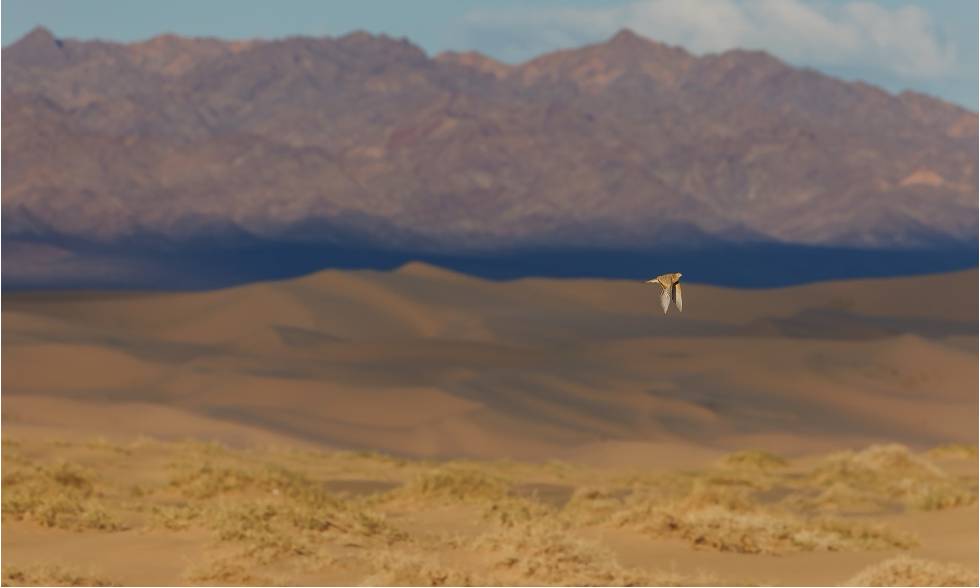
Saturday 24th May We were away from Dalanzadgad at 05:00 and drove for just over 30 minutes to Yolyn Am, where we spent the whole day. Our first stop was in slopes vegetated with dwarf juniper scrub on the drive up into the mountains. A group of 8 Pallas’s Sandgrouse flew over as we trawled for our desired quarry. The main target didn’t take too long to materialise – a responsive pair of MONGOLIAN ACCENTORS were soon in the bag. Other species in this area included Common Rock Thrush, Brown Accentor and White-winged Snowfinch. We then continued to the parking lot at the end of the road, where we had a field breakfast. After this, we walked downhill to Yolyn Gorge. Here we added a fine selection of species, notably Lammergeier, Himalayan Griffon, Crag Martin, Chinese Beautiful Rosefinch and Godlewski’s Bunting, with pride of place going to a responsive male Wallcreeper that graced the main gorge area. We had a field lunch at the same spot as we had taken breakfast and then back-tracked the way that we had come in and made another stop in the juniper slope area, where we had some flight views of a Barred Warbler. We descended to our ger camp at the base of the hills, where we were each allocated a spacious and well-presented ger (yurt). We had an early afternoon rest and then returned to the lower slopes of Yolyn Am, where we had much improved views of the Barred Warbler and finished with another fine encounter with a Mongolian Accentor. In the evening, back at the tourist camp, we were pleased to find the electricity working and (urgently required) luxurious hot showers.
Sunday 25th May We left our ger camp at Yolyn Am at 06:00 and spent the morning driving west to Khongorin Els. We had an enforced stop at a small village called Bayandalia en route, where the drivers had intended to refuel the vehicles but we had to wait some time for the gas station to open. A small lake kept us entertained for a while, it hosted a fair selection of species including several Garganey and a Terek Sandpiper that was foraging in a stony paddock. The next section of the drive, through low brushy flatlands, provided numerous sightings of Pallas’s Sandgrouse, including several on the deck. Later in the morning we stopped in a dry river wadi through rocky hills, where we saw several rather flighty Mongolian Finches. A nearby oasis hosted a few migrants including a Hume’s Warbler, Eurasian Siskin and 3 Daurian Shrikes. We arrived at our ger camp near a massive sand dune complex at Khongorin Els at about 13:00. We had lunch and an early afternoon rest before setting out to explore the area. A small low-walled compound near the dunes was home to a small breeding group of Saxaul Sparrows. We then drove to an area of dotted low scrub on a gentle slope, where we soon found a pair of Mongolian Ground-Jays, we even found a nest with tiny young. After a considerable search, we eventually found an Asian Desert Warbler, which was typically hyperactive and reluctant to show at close range. Monday 26th May We left Khongorin Els at 07:00 and spent most of the day driving north on rough (and at times non- existent) roads. 2 Mongolian Ground-Jays were seen in the first section of the drive. We got bogged down at a river crossing in a salt flats area and had to tow one of the cars out and then reorientate back towards a more major track. There were huge numbers of Pallas’s Sandgrouse around the salt flats, providing many memorable views. We stopped at Bogd town for lunch, before continuing onwards. The roads from there on pretty much disappeared; we were basically heading off-piste towards the mountain with frequent back-tracking as we came to impassable slopes. We eventually reached a dry gravelly valley that led up into the mountains – the last few kilometres were a slow old grind. We eventually got to our target area at the base of Baga Bogd Mountain at about 16:30. It didn’t take long to spot our first ALTAI SNOWCOCK, though it was very distant and slipped over the ridge after a couple of minutes of scope views. We then spread out to explore up and down the valley. I had walked a long way downslope when I got a call on the radio that Uugaa had spotted 2 more Altai Snowcocks a long way up the valley. It was a long, tough slog back up to where the others were scoping the birds, but the views were better and more prolonged this time. We clambered up a few hundred metres more to improve the views – a very satisfying encounter. Back at the camping spot (on hard rocks!), Alan spotted 6 more Altai Snowcocks on a distant ridge line. Other species observed in the area included Twite, Water Pipit and Golden Eagle. We had a tasty Mongolian chicken curry at our open-air dining area by our camp to round off a successful afternoon.
Tuesday 27th May I could hear an Altai Snowcock calling as I lay in my tent at Baga Bogd Mountain and Alan already had it in the scope by the time that I crawled out at 05:00. The bird proved to be responsive to playback and descended several times, eventually coming down to about 200 metres from the riverbed, offering prolonged scope views. An Alpine Accentor was seen near the camping area. We had an open-air breakfast at the camp site and then we walked down the valley whilst the crew packed up the gear. Things were generally quiet, though we did see several Isabelline Shrikes and a Barred Warbler. We then drove down out of the mountain and turned north and then west on the north side of the mountain range. We ended up at another town called Bogd (a different one to yesterday, despite the same name) and we spent the afternoon visiting 2 nearby lakes – Orog Nuur to the south of town and Kholboolj Lake to the north. We had a plethora of trip ticks, mainly waterbirds. We stayed in a basic hotel in town as Uugaa thought it might be too windy for camping – the place was nothing special but at least there were hot showers (though only 1 shower/toilet shared between 9 of us).
Wednesday 28th May We had a quick pre-breakfast look at the House Martin colony on the school at Bogd – they proved to be Western House Martins. We left the town at 07:30 and drove west across country to Boon Tsagan Nuur. The navigation, as during the last few days, involved following rough tracks in the general direction that we were heading then, when the tracks started veering away from our desired course, cutting off-piste across the steppe until we picked up the next track. By this method we eventually arrived at our destination just after midday. We spent the rest of the day birding along the shores of Boon Tsagan Nuur. We started in the southeastern corner, which at first seemed to be somewhat desolate in strong winds. Slowly cruising along the dirt tracks near the lake, we spotted a promising looking gull flying along the lakeshore. After a bit of confusion, we realised we had found the highly- desired Relict Gull. In fact, there proved to be at least 11 birds present. We had a late lunch at our accommodation – some basic sheds in a designated accommodation area near an observation tower. We then visited the area adjacent to the huts, where a river flowed in to (or out of) the lake at the easternmost end. This area was alive with birds and we had a prolific session amongst the waterbirds. The highlight was 6 Asian Dowitchers, but we also logged Dalmatian Pelican, another Relict Gull, 2 Pallas’s Reed Buntings, 2 Pallas’s Grasshopper Warblers and several Brown-headed Gulls. White-winged Black Terns were present in high numbers and both Common and Pacific Swifts provided some nice fly-by views. We finished with an evening return to the area where we had seen the Relict Gulls earlier; there were still a few present, with Red-throated Pipit and an immature Pallas’s Fish-Eagle also seen.
Thursday 29th May We had a pre-breakfast birding session along the lake shore at Boon Tsagan Nuur, revisiting the stretch where we saw the Relict Gulls yesterday. We found 3 birds still present, though they were again unapproachable and flighty. The scrubby area within the accommodation grounds harboured a Spotted Flycatcher and a Blyth’s Reed Warbler, whilst 3 Black Storks were scoped from the grounds. We left at about 08:30 for the long drive north to Khukh Nuur. The entire route was again on small dirt roads, with occasional off-piste sections. About 20 kilometres short of our destination, we finally saw some acceptable Siberian House Martins, with photos taken showing the diagnostic white longest uppertail coverts; it is likely that these were migrants, all the breeding colonies that we have examined were Western House Martins. We arrived at a very cold and fairly windy Khukh Nuur at about 16:30. We immediately began searching the sparsely bushed lower slopes of the hill above the lake for our target species. An initial claim/sighting of White-throated Bushchat was too brief to be sure that we hadn’t been fooled by a Siberian Stonechat (a pair of which were present), but there was no doubting the pair of Rufous-backed (Eversmann’s) Redstarts that we saw shortly afterwards. Whilst watching the Redstarts and Siberian Stonechats, an underwhelming female chat type begged attention, we eventually concluded that it was a female White-throated Bushchat. Sulphur-bellied Warbler and Saker Falcon also made appearances. We figured we just about had time to pay a visit to the slopes above the smaller lake about 3 kilometres away, that seems to be a better spot for the Bushchat. However, the drive there took us rather longer than expected and, in the end, we turned back before we reached the spot, though we did get some nice views of Water Pipit and Citrine Wagtail as we returned to the camping spot, where we settled down for a cold, windy night in the tents.
Friday 30th May We were up early for a 05:00 breakfast – it was mind-numbingly cold, the drinks in my tent had frozen to ice, the temperature showed as -5 Centigrade. After a quick breakfast, we drove back to the Bushchat site near the small lake a little south of the main lake at Khukh Nuur. Almost as soon as we got out of the car, a pair of WHITE-THROATED BUSHCHATS was spotted – the final target bird of the trip was under the belt. We spent the morning searching the slopes in this area, enduring the biting cold and moderate strength winds, gradually working our way higher up the scree. We saw several more White-throated Bushchats and fair numbers of Altai Accentors; it was quite a challenge trying to photograph them with frozen fingers. At the highest altitude that we reached (about 3080 metres asl), Alan’s relentless scanning was rewarded when he found an Asian Rosy Finch feeding on a distant snow patch. We gingerly approached across tricky scree slopes, stopping every 50 metres or so to upgrade our views. In the end we got views down to about 10 metres and watched 3 individuals at length before we made the long and difficult descent back to the vehicles. We returned to the camp site for lunch and then had an early afternoon nap in the tents. We spent the later part of the afternoon walking the shores of the main lake and the adjacent lower scree slopes. 4 very distant Stejneger’s Scoter were scoped on the lake, whilst the slopes yielded several Eversmann’s Redstarts, a pair of White-winged (Guldenstadt’s) Redstarts and a couple of confiding Hume’s Warblers. We had dinner at 19:00 and then retreated back into the tents for a long night.
Saturday 31st May We had a relatively lazy start at Khukh Nuur, rising from our tents at 06:00 to calm winds and (compared to yesterday) a balmy zero degrees centigrade. A jaunt around the hillside near the camp site and along the lake shore provided some nice views of Pallas’s Reed Buntings and a male Red- spotted Bluethroat. We were packed up and on our way by 08:15 for the long drive to Gun Lake. We arrived at the lake at 17:20 and we were a little disappointed to find a relatively small lake with no marginal vegetation. However, a Grey-headed Lapwing and a first summer Relict Gull were good finds at the first part of the shore that we checked. We did a full circumnavigation of the lake in the vehicles, walking the last part. A decent variety of waterbirds was present, though no additional standout species. We camped by the lake shore.
Sunday 1st June An early morning walk along the shore of Gun Lake revealed lower numbers of several species compared to yesterday, though 3 Red-necked Phalaropes were new for the trip. We spent some time photographing Mongolian Larks in the adjacent grasslands prior to our 08:20 departure. We stopped for lunch at Takhilt Lake, where we added a few more species to our trip list. Most notable was a pair of White-naped Cranes with 2 small chicks and at least 2 Slavonian Grebes. An Oriental Honey- Buzzard that came down to drink and 4 distant Asiatic Dowitchers provided additional interest. As we continued onwards, we stopped at a service station along the way, where an adjacent road bridge hosted a small colony of House Martins. These offered excellent photographic opportunities and again they proved to be Western House Martins, with a single bird that showed mixed Siberian/Western House Martin characters present, presumably a hybrid/intergrade. We arrived at our rather pleasant ger camp (with en suite showers!) at about 16:20. We had a short rest and then drove a little further south to Hustai National Park. A huge sand storm loomed over us as we left the camp and we had to drive through it in low visibility for a few kilometres. Once in the park, the drivers seemed to want to set new land speed records and we whizzed along at an absurd pace. It didn’t take long to reach a valley where at least 4 herds of Przewalski’s Horses, totalling about 50 individuals, were found. We spent some time admiring these handsome animals. We then sped along further into the park, reaching some scrub-dotted hillsides. The weather was pretty awful – wet and windy, so in the end we didn’t linger and raced back to the camp for a relatively early finish.
Monday 2nd June A morning session in Hustai National Park added Thick-billed Warbler and Meadow Bunting to the trip tally and we had some further encounters with Przewalski’s Horses in the same valley as yesterday. We then drove onwards to Ulaanbaatar, where we again checked in to the Mongolica Hotel, where we had lunch. A late afternoon session in the environs of the hotel was much less productive than on our visit 2 weeks ago; there was a general dearth of migrants and a single White- crowned Penduline Tit was the pick of the action.
Tuesday 3rd June We left the hotel at 05:30 in a taxi that took us to the airport, some distance south if the city. Our Turkish Airlines flight took off about 20 minutes late at about 09:00. We had a 5-hour transit time in Istanbul before the final leg home to London, where a luggage belt malfunction led to a long wait to retrieve our bags. It was nearly midnight by the time that I got home to Ware. The trip list was 202 species seen (plus just 1 heard only), of which 4 were new birds. Full species list: The complete systematic list ran to 202 species recorded in the field (plus one heard-only), headed by Black-billed Capercaillie, Altai Snowcock, Relict Gull, Pallas’s Sandgrouse, Mongolian Ground Jay, Henderson’s Ground Jay, Przevalski’s Rosefinch and a wide range of waterfowl, waders, raptors and steppe and desert specialities recorded across the trip’s lake, steppe, mountain and desert habitats.
Species heard only BLACK WOODPECKER 1 responded distantly at Zamt.
Mammals PALLAS’S PIKA Very common Yolyn Am. DAURIAN PIKA 1 Hustai NP. TOLAI HARE 1 Baga Gazriin. GOBI ALTAI MOUNTAIN VOLE 1 Yolyn Am. BRANDT’S VOLE Several Baga Gazriin. MONGOLIAN JIRD 2 Yolyn Am. TARBAGAN MARMOT 1 Zamt, small numbers Khukh Nuur, very common Hustai NP. “Very tasty” according to the drivers, which probably explains is rarity away from protected areas. SIBERIAN CHIPMUNK 2 Zamt. LONG-TAILED GROUND SQUIRREL Singles Zamt and Hustai NP. ALASHAN GROUND SQUIRREL 4 Yolyn Am. WAPITI A few Hustai NP & Ulaanbaatar. GOITERED (BLACK-TAILED) GAZELLE A couple of sightings in the south. MONGOLIAN GAZELLE A herd of about 15 south of Ulaanbaatar, before the turn off for Baga Gazriin. SIBERIAN IBEX About 12 Yolyn Am. PRZEWALSKI’S HORSE About 50 Hustai NP. RED FOX 1 Hustai NP. CORSAC FOX 2 Baga Gazriin, 1 Khukh Nuur, 1 Hustai NP.
Butterflies OLD WORLD SWALLOWTAIL 1 photographed in the Dalanzadgad/Yolyn Am area. ARICIA CHINENSIS A few of this Brown Argus type butterfly seen in Hustai NP and near Ulaanbaatar. SMALL TORTOISESHELL 2 Zamt. GLANVILLE FRITILLARY 1 Hustai NP. FREIJA FRITILLARY Boloria Freija A few Khukh Nuur.
Herptiles TUVAN TOAD-HEADED AGAMA Phrynocephalus versicolor A few seen at Baga Gazriin and other desert sites in the south. MULTI-OCELLATED RACERUNNER Eramius multiocellata 1 photographed at Gaga Gazriin looks to be a good match for this species.
Istanbul transit stop 19/05/25 FERAL PIGEON COLLARED DOVE LAUGHING DOVE COMMON SWIFT YELLOW-LEGGED GULL WHITE STORK PYGMY CORMORANT GREAT CORMORANT GREY HERON RING-NECKED PARAKEET COMMON MAGPIE EURASIAN JACKDAW HOODED CROW GREAT TIT EURASIAN STARLING COMMON MYNA HOUSE SPARROW


© 2026 Tum-Eco Tour Co.,Ltd. All right reserved. Developed by Mind Agency